Big Buddha Temple Koh Samui
History, Meaning & Visitor Guide
Wat Phra Yai, better known as Big Buddha Temple, is one of Koh Samui's most recognizable Buddhist landmarks. The 12-metre golden Buddha on Koh Fan is impressive from a distance, but its real meaning becomes clearer when you understand the Buddha's earth-touching posture, the story of Mara and the symbols placed throughout the temple grounds.
In This Guide
The Big Buddha of Koh Samui
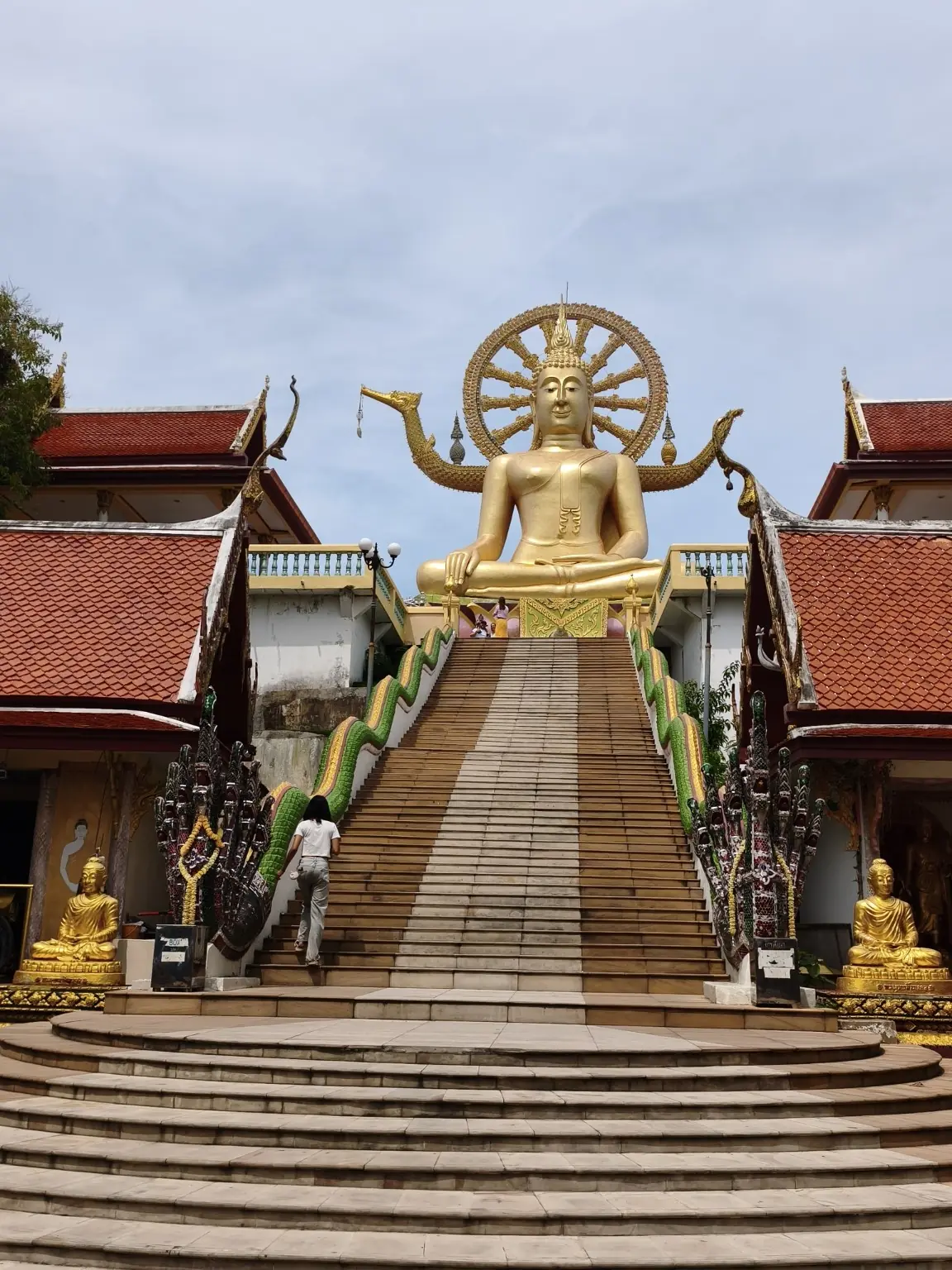
The main Buddha image at Wat Phra Yai is known as Phra Buddha Santi Teepanat. According to the official information board at the temple, construction began in 1972 and was completed in 1974. The seated golden image is approximately 12 metres high and stands above the lower temple grounds on Koh Fan.
The size of the image makes it a famous Koh Samui landmark, but the most important detail is the Buddha's posture. His left hand rests calmly in his lap while his right hand reaches down over the right knee toward the earth.
The Buddha's posture: Calling the Earth to Witness
This gesture is called Bhumisparsha Mudra, often translated as Calling the Earth to Witness. In Thailand the image is commonly understood as the Mara-Vijaya posture, or the Buddha subduing Mara.
The posture represents one of the most important moments in the Buddha's life, immediately before enlightenment. It is not simply a decorative pose: the hand touching the earth tells a specific story about steadfastness, accumulated merit and the overcoming of obstacles on the path to awakening.
The Buddha's victory over Mara
According to Buddhist tradition, while Siddhartha Gautama was meditating beneath the Bodhi tree, Mara attempted to prevent him from reaching enlightenment. Mara is represented in the story as an adversary and can also be understood symbolically as fear, desire, doubt, temptation and other forces that disturb the mind.
The future Buddha remained peaceful and unmoved. When Mara challenged his right to attain enlightenment, he lowered his right hand and touched the earth, calling the Earth to witness the merit he had accumulated through countless good deeds.
The giant Buddha at Wat Phra Yai represents this moment. The downward-pointing right hand is therefore central to understanding the statue. Soon after this event in the traditional story, Siddhartha Gautama attained enlightenment and became the Buddha.
Phra Mae Thorani – the Earth as witness
On the left side of the temple entrance, visitors can see a sculpture connected directly with the story represented by the Big Buddha. It depicts Phra Mae Thorani, the Earth Goddess in Thai Buddhist tradition, appearing as witness to the Buddha's accumulated merit during his confrontation with Mara.
This makes the sculpture especially meaningful at Wat Phra Yai: the scene below explains the story, while the huge Buddha above shows the earth-touching gesture itself. Visitors who understand the two together can see that the temple is presenting an important episode from the Buddha's life rather than simply a collection of statues.
History of Koh Fan and Wat Phra Yai
The Big Buddha stands on Koh Fan in the north-east of Koh Samui. The temple's official information board records that the area was historically connected with Wat Plai Laem and had previously been used as a burial place for babies and young children.
Around 1970, Phra Khru Santi Nontakun developed the area by establishing monastic facilities and places for Dhamma practice. Construction of the main Big Buddha began in 1972 and was completed in 1974, creating the landmark visitors see today.
Phra Khru Santi Nontakun and the development of Koh Fan
The statue in this area commemorates Phra Khru Santi Nontakun, the abbot closely associated with the development of Koh Fan as a Buddhist site. His role is important to the history of Wat Phra Yai because the site was developed for monastic life and Dhamma practice before construction of the Big Buddha began.
The dates and historical details above are based on the official information board photographed at Big Buddha Temple during our on-site visit.
Guardian giants and the temple entrance
At the entrance, a pair of large guardian giants stand on either side of the gateway. Guardian figures like these are common in Thai Buddhist temple architecture and symbolically protect the sacred area.
The entrance is also where visitors can check the temple's current opening hours and dress rules. At the time of our latest visit, the sign displayed opening hours of 7:00 AM to 6:30 PM.
Dress respectfully when visiting
Wat Phra Yai is an active Buddhist temple, so visitors should dress respectfully. The entrance sign specifically warns against revealing clothing such as swimwear, very short shorts and strapless or similar tops.
If you arrive dressed for the beach, cover-up garments are available at the temple. This is useful on Koh Samui, where many visitors combine temples and beaches in the same day.
- Cover shoulders and knees before entering religious areas.
- Remove shoes where temple signs or local custom require it.
- Speak quietly around people who are praying.
- Do not climb on religious statues or pose disrespectfully with Buddha images.
The 75-step Naga staircase
The long staircase leading directly toward the Big Buddha contains 75 steps, a number also stated on the temple's official information board. The staircase is one of the most recognizable views at Wat Phra Yai and creates a dramatic approach to the golden image.
Naga serpent railings run along the sides of the staircase. Nagas are important figures in Buddhist and regional religious art and are commonly used around stairways and sacred spaces in Thai temples.
The seven-headed Naga Muchalinda
Near the staircase visitors can also see a seven-headed Naga associated with Muchalinda. This connects the temple with another episode from the Buddha's life.
According to Buddhist tradition, after the Buddha attained enlightenment, a severe storm arose while he was meditating. The Naga king Muchalinda protected him from the rain and wind. The seven-headed Naga therefore represents protection and another important story associated with the Buddha.
At the upper Buddha platform
After climbing the 75 steps, visitors reach the platform surrounding the Buddha. From close range the scale of the image becomes much more apparent, and visitors can study the earth-touching hand gesture that gives the statue its meaning.
Behind the Buddha is a large Dharma Wheel, another important Buddhist symbol. The wheel represents the Buddha's teaching, the Dharma, and the spreading of those teachings after enlightenment.
A temple close to Samui Airport
Wat Phra Yai is located close to Samui International Airport. Depending on the flight route and schedule, aircraft can occasionally be seen passing above or near the temple.
Seeing an aircraft overhead is not guaranteed, but when it happens it creates a memorable contrast between a modern passenger plane and one of Koh Samui's best-known Buddhist landmarks.
Making merit with flowers, incense and candles
Visitors who would like to pay respect in the traditional Thai Buddhist way can obtain flowers, incense and candles at the temple. At the time of our latest visit, a worship set was available for 20 THB.
Making an offering is optional. Visitors of any faith are welcome to observe respectfully without purchasing anything.
Sangkhathan offerings
Another form of merit-making available at the temple is Sangkhathan, an offering of useful items to the Buddhist monastic community. Prepared sets are available and there is a designated area for making the offering.
At the time of our visit, prepared Sangkhathan sets were 199 THB per set. These prices are on-site observations and may change in the future.
Buddha images for the day you were born
The lower temple grounds also contain Buddha images representing different days of the week. In Thai Buddhist tradition, many people pay respect to a Buddha posture associated with the day on which they were born.
Visitors may see Thai worshippers making merit or offering a donation at the image associated with their birth day. It is a useful example of how stories and postures of the Buddha remain connected with everyday religious practice in Thailand.
Other respected Buddhist figures in the temple grounds
Although the main story of Wat Phra Yai centres on the Buddha, visitors will also see statues of Buddhist figures and respected Thai monks. These include Luang Pu Thuat, Somdet Phra Phutthachan To Phrommarangsi and Phor Than Klai Wajasit.
There are also statues of Phra Sangkajai and Phra Sivali. These figures are secondary to the main Big Buddha, but they help visitors understand the variety of devotional traditions found in Thai temples.
Take time to explore the lower temple grounds
Many visitors walk directly to the staircase, photograph the Big Buddha and leave. Doing that means missing much of the story. Before climbing, look for the Phra Mae Thorani scene, the seven-headed Naga, the day-of-birth Buddha images, the offering areas and the statues of respected monks.
There are also small shops near the approach to the temple. A slower visit gives much more meaning to a place that can otherwise look like only a famous Koh Samui photo stop.
How long should you spend at Big Buddha Temple?
Around 30 to 45 minutes is comfortable for a normal sightseeing visit. Visitors who want to understand the Buddhist stories, make an offering, explore the lower grounds and spend time at the upper platform may want to stay longer.
The upper platform requires climbing the 75-step staircase. Visitors with limited mobility should take this into account, although much of the lower temple area can still be explored without climbing to the top.
Temple etiquette
Remember that Wat Phra Yai is both a major visitor attraction and a place of worship. Avoid loud behaviour, respect people who are praying, and do not point the soles of your feet directly toward Buddha images or monks.
Most importantly, the Big Buddha is not simply a tourist monument. For Buddhist visitors it represents the Buddha and an important moment immediately before enlightenment.
Take your time, look at the details, and the Big Buddha begins to tell the story of the Buddha rather than simply serving as a famous Koh Samui photo stop.
Frequently Asked Questions
Why is the Big Buddha touching the ground?
The right hand touching the earth represents Bhumisparsha Mudra, or Calling the Earth to Witness. It recalls the moment before enlightenment when the Buddha called the Earth to witness his accumulated merit during his confrontation with Mara.
How tall is the Big Buddha in Koh Samui?
The seated golden Buddha at Wat Phra Yai is approximately 12 metres high.
How many steps are there at Big Buddha Temple?
There are 75 steps leading from the lower temple area to the platform around the Big Buddha.
What is the seven-headed serpent beside the staircase?
It is a Naga associated with Muchalinda, the Naga king who according to Buddhist tradition protected the Buddha during a storm after enlightenment.
Who is Phra Mae Thorani?
Phra Mae Thorani is the Earth Goddess in Thai Buddhist tradition. At Wat Phra Yai, her sculpture relates directly to the Buddha's earth-touching posture and the story of the Earth witnessing his accumulated merit.
What are the opening hours of Big Buddha Temple?
The entrance sign photographed during our latest visit showed opening hours of 7:00 AM to 6:30 PM. Visitors should check the current sign on arrival because hours can change.
What should I wear to Big Buddha Temple?
Dress respectfully with shoulders and knees covered. Avoid swimwear, very short shorts and revealing tops. Cover-up garments are available at the temple if needed.
Can visitors make offerings at the temple?
Yes. Flowers, incense and candles are available, and visitors may also make Sangkhathan offerings. Making an offering is optional.
Can you see airplanes from Big Buddha Temple?
Sometimes. The temple is close to Samui Airport, so aircraft may occasionally pass overhead or nearby depending on the flight route and schedule.